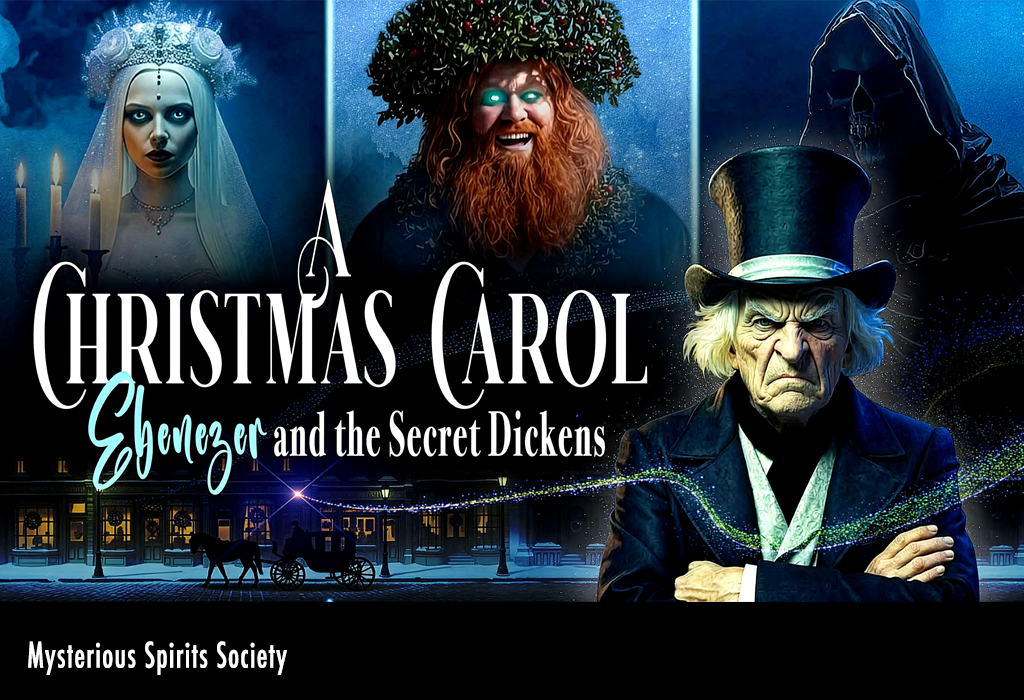
Ebenezer and the Secret Dickens
“Bah, humbug!”
― Ebenezer Scrooge
Not all things Christmas are merry and bright—Winter’s long nights chilled bones huddled by the warmest fires. Generations of shadowy tales merged with yuletide celebrations, and for Victorian England, none was more synonymous with haunted Christmases than novelist, mesmerist, supernaturalist, and benevolent ghost, Charles Dickens.
The Novelist
Victorian wintery ghosts flourished, fueled by Britain’s industrialization, scientific advancements, and global uncertainties.
To feed such appetites, Dickens penned ghost stories despite being a ‘fascinated sceptic’.
Dickens’ literary style summarized 19th-century culture with humorous details of daily life.
He also championed Britain’s struggling working class. His father, a victim of debt and ruthless creditors, forced an adolescent Charles to toil long hours; a servitude to which he rarely spoke, but revealed such inequities in his writings.
A Christmas Carol is Dickens’ masterpiece of greed, ghosts, and redemption.
Ebenezer Scrooge, miserly in his wealth and unscrupulous in his business, even upon a Christmas Eve, retreats for solitude at his estate.
It is there that he is greeted by a ghost, that of his previous business partner, bound in purgatorial chains. Scrooge dismisses the visitation as an overactive imagination, yet he is warned of three approaching apparitions,
one more terrifying than the next —
One of squandered youth, one of tragic souls, and one of the cold finality of a life unrepentant. All torturous messengers in Ebenezer’s dark dreams.
By dawn, Scrooge will be miraculously transformed after his ordeal. And just in time for Christmas.
The Mesmerist
Dickens himself was not particularly religious, nor believed in the spirits of which he wrote.
He was, however, an avid Mesmerist with John Elliotson, the renowned British physician, his acting mentor.
Ghosts, Charles felt, were manifestations of an internal nature, rather than an external force; an ailment that could be cured responsibly, rather than regretfully.
The Supernaturalist
In 1862, Dickens was a skeptic participant in London’s paranormal research organization, The Ghost Club.
Composed by prominent intellectuals, investigations of spiritualism’s validity and explanations for its phenomena were debated, often in secret, with little documentation left behind.
Dickens’ participation remained vigilant until his death. Or perhaps, beyond it.
The Ghost from the Beyond
Dickens’ death preceded the completion of his novel, The Mystery of Edwin Drood, A Part Second completion was published 3 years later. Its publisher claimed the final manuscript was received from channeling sessions with the deceased author.
Debate ensued over its authenticity.
Spiritualist Sir Arthur Conan Doyle, over a decade later, agreed on its credibility. Then, recanted his approval after Dickens’s spirit in a seance told him otherwise. Doyle had also been an alumnus of The Ghost Club.
Such ironies of being a reputable spirit, Dickens must enjoy from his place far beyond, surrounded by his marvelously invented, benevolent ghosts.